A network-related or instance-specific error occurred while establishing a connection to SQL Server. The server was not found or was not accessible. Verify that the instance name is correct and that SQL Server is configured to allow remote connections. (provider: Named Pipes Provider, error: 40 - Could not open a connection to SQL Server) Study shows tiny black holes may not account for dark matter as stated by Stephen Hawking, Global : Today Indya

Latest News

  • Home
  • Global
  • Study shows tiny black holes may not account for dark matter as stated by Stephen Hawking
Study shows tiny black holes may not account for dark matter as stated by Stephen Hawking
Thursday, April 4, 2019 IST
Study shows tiny black holes may not account for dark matter as stated by Stephen Hawking

For a whole night, the research team took 190 consecutive images of Andromeda galaxy


An international research team including Dr. Surhud More and Dr. Anupreeta More from Inter-University Centre for Astronomy and Astrophysics (IUCAA), Pune has ruled out the possibility of primordial black holes being a major constituent of dark matter. This finding disproves a theoretical claim of Prof Stephen Hawking.
 
Dark matter
 
In the solar system, Mercury, the planet closest to the Sun, takes just 88 days to make one revolution around the sun, while Neptune, the farthest one, takes 165 years to make one round. In like manner, laws of gravity expect us to see stars closer to the centre of galaxies rotating faster than the stars on the edge.
 
However, in most galaxies, the stars closer to the centre and the stars at the edge of the galaxies take almost same time to make one revolution. This implied that something invisible and enveloping the galaxies was giving an extra push to the outer stars, speeding them up. This entity has remained as one of the central unresolved puzzles in cosmology since 1930s. It is, no wonder, named `Dark Matter’.
 
The material is considered to be a ‘matter’ since it appears to have gravitational attraction and it is ‘dark’ because it does not seem to interact with light (or for that matter any part of the electromagnetic spectrum). Detailed surveys of the cosmos indicate that almost 85% of the total mass of the Universe is composed of dark matter. Thus, stars, galaxies, and atoms that we see all around are just the tip of the iceberg and the elusive dark matter makes up the bulk of the Universe.
 
Primordial black holes
 
Cosmologists have come up with various hypothesis and theories to explain the dark matter. Some postulate it to be composed of neutrinos, which are particles that have no charge but have tiny mass and, therefore, do not have interact with electromagnetic spectrum, but are gravitationally interacting. Some others have postulated they may be some new kind of elementary particles - `weakly-interacting massive particles (WIMPs)’, or `gravitationally-interacting massive particles’ (GIMPs), which are yet to be detected.
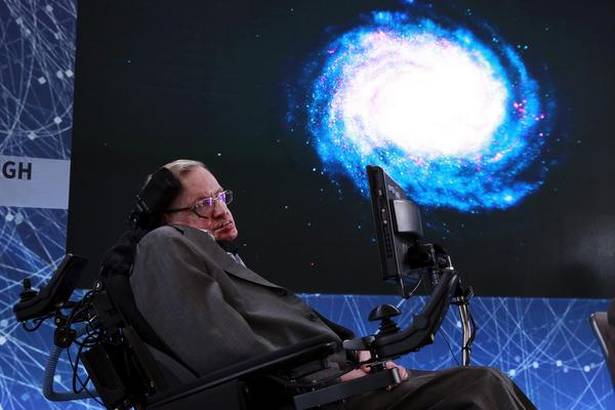
 
 
When the big bang hypothesis was proposed, two Soviet physicists, Yakov Borisovich Zel'dovich and Igor Dmitriyevich Novikov, showed that at the initial instant of the big bang, the densities would have been very high at many points, resulting in the formation of small black holes. They were named `primordial black holes’. Stephen Hawking investigated them in 1971. He computed that the mass of the primordial black holes could range from as low as one-hundredth of a milligram to as high as more than the mass of thousand Suns.
 
Gravitational lensing
 
Black holes are not radiant and will not be visible through any telescope. However, as first suggested by Albert Einstein, if by chance, a tiny primordial black hole eclipses a distant star, light rays of the star will bend around the black hole due to gravitational effect, resulting in the star appearing to be brighter than it originally is for a short while. Called `gravitational lensing’, this rare phenomena can occur only when the star, the black hole and the observer on the Earth are aligned in a straight line.
 
When the black hole is in alignment with a distant star, due to gravitational attraction, light rays are bent inwards like a lens, making the star appear brighter.
 
The research team, which was led by Masahiro Takada, Hiroko Niikura and Naoki Yasuda from Kavli Institute for the Physics and Mathematics of the Universe used the Hyper Suprime-Cam on the Japanese Subaru Telescope located in Hawaii to look for any tell-tale evidence of primordial black holes between Earth and Andromeda galaxy using gravitational lensing technique.


Looking for the flash
 
It would be absurd- like searching for a needle in haystack, if we keep looking at one star and hope some time or other an invisible primordial black hole will eclipse it.
 
The research team, consequently, kept observing the entire disk of the Andromeda galaxy consisting of lakhs of stars. Now, there is a chance for some primordial black holes, if they do exist in sufficient numbers, eclipsing any of these stars becomes significant.
 
 
“The investigation is delicate and tricky. The eclipsed star may brighten up for a period of a few minutes or a few hours due to gravitational lensing, requiring the team to take multiple images to catch the flicker, if any” says Dr. Anupreeta More, a member of the team.
 
For a whole night, the research team took 190 consecutive images of Andromeda galaxy. “If the Universe is filled with invisible teeny weeny primordial black holes, with masses lighter than the moon, as postulated by Stephen Hawking, then we should have seen at least 1,000 gravitational lensing events. We saw at most one such candidate event, if not none. This implies Prof Stephen Hawking’s theory that such black holes make up all of dark matter is wrong,” says Dr. Anupreeta.
 
“Previous studies had already ruled out the existence of large numbers of primordial black holes that could range in size from the mass of the Moon to about 10 solar masses. The present study rules out the presence of primordial black holes with masses comparable to the moon and sizes of about 0.1 millimetre too. This implies that at best the lunar mass primordial black holes can contribute 0.1% of all dark matter mass” says Dr. Surhud More, another member of the research team.
 
A report on the work has been published in Nature Astronomy.


Related Topics


Trending News & Articles

 Article
'Worse than prison': A rare look inside China's detention camps to 'brainwash' Muslims

ALMATY: Hour upon hour, day upon day, Omir Bekali and other detainees in far western China's new indoctrination camps had to disavow the...

Recently posted . 219K views . 1 min read
 

 Article
What The Shape Of Your Belly Button Says About Your Health

If you have payed attention to the belly buttons of people on the beach or the members of your family, you have probably noticed that they have different shapes and...

Recently posted . 10K views . 2 min read
 

 Article
New ‘Langya’ virus hits China as 35 people found infected: How deadly is it?

The Langya henipavirus has a place with a similar group of infections, including Nipah, which is known to kill up to 3/4 of people in extreme cases.

Recently posted . 6K views . 1 min read
 

 Article
Queen Elizabeth Dies At 96: The New Royal Line Of Succession

Queen's death: The eldest of her four children, Charles, Prince of Wales, who at 73 was the oldest heir apparent in British history, became king immediately...

Recently posted . 5K views . 1 min read


More in Global

 Article
Indian, Afghan spy agencies patronising terror, Pakistan tells US

Pakistan on Wednesday passed on to the US that India's Research and Analysis Wing (RAW) and Afghanistan's National Directorate of Security (NDS) are belittl...

Recently posted. 786 views . 11 min read
 

 Article
KIDS FACTS ABOUT SILKWORMS

  Silk has long been prized as a luxury fabric the world over for thousands of years. Few people understand it's a labor-intensive effort ...

Recently posted. 915 views . 2 min read
 

 Article
NASA Video Shows a Black Hole Ripping Apart an Unfortunate Star the Size of Our Sun

The star was eventually sucked into oblivion in a rare cosmic occurrence that astronomers call a tidal disruption event.

Recently posted. 1K views . 0 min read
 

 Video
Naver Celebrate Too Early


Recently posted . 986 views
 

 Reviews
The Best 5 Hiking Backpacks in India – Reviews & Buying Guide


Recently posted . 3K views . 140 min read
 

 Article
In a first under Justin Trudeau, Canada lists Khalistani extremism as threat

Sikh groups Babbar Khalsa International and the International Sikh Youth Federation, which are already on Canada's watch list, remain listed as terror entitie...

Recently posted. 1K views . 1 min read
 

 Article
8 Free Ambient Noise Sites That'll Transform Your Open Workspace Into a Private Office

When you’re buckling down to get through a hefty to-do list, the environment that you’re in has a huge impact on your ability to concentrate and work ef...

Recently posted. 1K views . 2 min read


   Prashnavali

  Thought of the Day

“Use your smile to change the world, don’t let the world change your smile.”
Anonymous

Be the first one to comment on this story

Close
Post Comment
Shibu Chandran
2 hours ago

Serving political interests in another person's illness is the lowest form of human value. A 70+ y old lady has cancer.

November 28, 2016 05:00 IST
Shibu Chandran
2 hours ago

Serving political interests in another person's illness is the lowest form of human value. A 70+ y old lady has cancer.

November 28, 2016 05:00 IST
Shibu Chandran
2 hours ago

Serving political interests in another person's illness is the lowest form of human value. A 70+ y old lady has cancer.

November 28, 2016 05:00 IST
Shibu Chandran
2 hours ago

Serving political interests in another person's illness is the lowest form of human value. A 70+ y old lady has cancer.

November 28, 2016 05:00 IST


ads
Back To Top