A network-related or instance-specific error occurred while establishing a connection to SQL Server. The server was not found or was not accessible. Verify that the instance name is correct and that SQL Server is configured to allow remote connections. (provider: Named Pipes Provider, error: 40 - Could not open a connection to SQL Server) How India Became Poor, History & Classics : Today Indya

Latest News

How India Became Poor
Monday, July 2, 2018 IST
How India Became Poor

Global market forces, colonization, and the decline of India’s empires led to the world’s mightiest economy becoming one of its poorest


Ask any Indian today why our country is poor and pat comes the reply: 300 years of rule by the British. This impression has been more deeply ingrained in recent times thanks to Dr. Shashi Tharoor’s eloquent arguments against colonial rule in popular media.
 
It’s undeniable that India lost its position as one of the great trading areas of the world, and was poorer after colonial rule than before it. But to put the blame squarely on the shoulders of the British is to give a tiny minority in charge of a minimal state a little too much credit. The real culprit, I argue, was market forces tilted to favour the West — a beast that we still struggle with today.
 
 
After the rule of the last Great Mughal, Aurangzeb, the Mughal Empire, overextended and fiscally strained, began a slow decline. Its vassals and rivals tore it apart. As the Indian subcontinent entered a period of protracted political strife, this led to changes in the structure of the economy as well. For starters, bankers and merchants began to rely more on loans to local warlords than investing in merchants and trade for income.
 
Tirthankar Roy argues that trade in general was limited to practically autonomous regions, with agricultural areas supplying urban areas, where specialized and increasingly out-of-business artisans served the declining aristocracy. Seaborne trade flourished but was dominated by wealthy caste and family-based companies who could afford to build ships . These couldn’t compete with European joint-share companies which could mobilize more capital, and spread risk among far more shareholders. Meanwhile, the decline of the central bureaucracies led to an increasing number of zamindars who started off as tax farmers but then became independent, de facto. The vast majority of the population scratched out a hard existence in the agricultural hinterland. All this needs to be seen in the light of larger changes in the global economy.
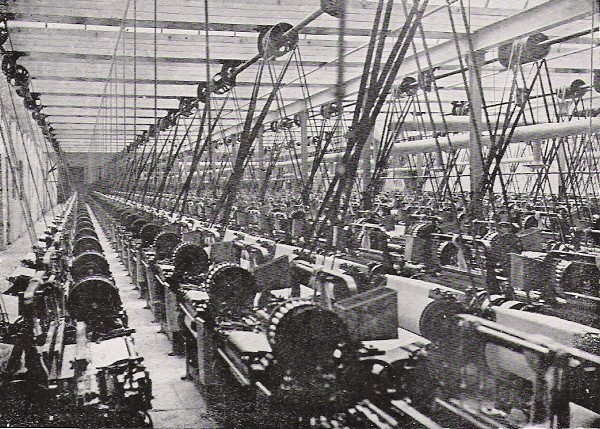
 
 
As industrialization took hold in Europe and the “satanic mills” were established, the cost of labour decreased, and the productivity of labour increased. For factories to become more profitable, cheap raw material was needed (which, thanks to limited land in Europe, wasn’t easily available). Enter the New World with its unlimited land, and India with its massive agricultural population. The Mughals had up to this point kept the British limited to a few ports in India, enabling Indian handicraft industries to survive.
 
All that changed as the empire declined and Britain gradually became the premier European power in India. Existing institutions were reshaped in its own favour. Investment in public goods began to take off, and a uniform currency was introduced. The welter of competing revenue rights on agricultural land was re-negotiated with zamindars. Most importantly, as India was forcibly opened to the global market, British joint-stock companies and railroads finally penetrated to the agricultural hinterland and connected supply (cheap raw material) with demand (industries in Europe).
 
So Britain began to leap ahead, buying ridiculously cheap raw materials, processing them in factories, and selling finished goods in India. The profits fueled investment in industrial technology, and productivity increased as agricultural workers moved to industrial jobs. Meanwhile, increasingly unemployed Indian artisans in handicraft industries returned to the agricultural jobs to eke out a living, since the demand for agricultural raw material was so huge. Thus began the “de-industrialization” of India.
 
 
Within a few decades from the 1860s to the 1920s, industries continued to become more productive, as they were only constrained by technology, and so European workers eventually achieved better standards of living. Agriculture, however, cannot indefinitely become more productive, as land is limited. And as a primarily agricultural nation, rural India quickly hit peak productivity and stagnated. And so Indian workers continued to remain in poverty.
 
Meanwhile Europe developed faster and faster. Global trade increased in volume, but India’s handicraft industries had lost their workers to the stagnant agricultural pool and it was unable to take advantage of this trend. With an economy that was stuck in a dead end, it’s not really a surprise that India fell behind Europe — one could say that the cards were literally stacked against it. And so India’s premier position in global trade was lost.


But did globalization really do nothing for India?
 
The fundamental problem with saying “India became poor” is that it applies the term “India” to an extremely large and diverse subcontinent. While the stagnation of agriculture was a massive issue in the hinterland, urban centers industrialized to a considerable extent, with Bombay’s cotton industries selling more in the subcontinent than Lancashire did by the turn of the 20th century.
 
 
Furthermore, unified currencies, language, and legal codes proved to have considerable positive externalities for some classes, such as the Parsees and other merchant communities (fun fact: the Tata family, which comes as close to capitalist royalty as any, made its fortune in the global opium trade before shifting to cotton and steel).
 
Black and white narratives of the British as evil conquerors are tinged with a nationalist lens. For starters, they never lacked for Indian partners, from merchants to princes. India itself was hardly a land of milk and honey for all of its people before the Raj.
 
A clearer look at the costs and benefits of colonial rule reveals a mass of contradictions, with some regions doing very well, some not changing much, and others being driven into poverty. The subcontinent was and is too diverse to generalize: it might help us better deal with the legacy of the Raj if we were to start seeing it in shades of grey, and calmly assess its shadow over the birth and development of the land called India.


Related Topics


Trending News & Articles

 Article
Nostradamus prediction : India will produce the immortal ruler

Quatrain 75, Century X Long awaited, he will not take birth in Europe,  India will produce the immorta...

Recently posted . 20K views . 2 min read
 

 Article
Dark side of Alauddin Khilji's sexuality and Baccha Bazi that led to his brutal death!

Secret's of Alauddin Khilji's sexuality Several historians argue that the roots of ancient Indian history, especially linked to ...

Recently posted . 8K views . 1 min read
 

 Article
Untold Truth Behind Rani Padmavati & Alauddin Khilji That You Need To Know

There are various challenging stories about Rani Padmavati otherwise known as Padmini. While from one viewpoint, the Rajputs keep up the holiness of everything iden...

Recently posted . 5K views . 1 min read
 

 Article
A newborn kangaroo is about as long as a paperclip

The kangaroo is a marsupial. A distinctive characteristic common to marsupials is that, with most, the young are carried around in a pouch. They are mainly found in...

Recently posted . 5K views . 1 min read


More in History & Classics

 Article
10 Bloody And Shameful Civil Wars

Civil wars are merely an indication that even people who are closely related by ethnicity, culture, history, and geography, can have deep and divisive diff...

Recently posted. 1K views . 41 min read
 

 Article
Lachit Bhorphukan: Hero From Assam Among Famous Warriors Who Stopped Mughals From Conquering Northeast India

Lachit Bhorphukan was a great warrior from Assam, where he was a commander of the army of the Ahom Kingdom. Lachit bravely defeated the powerful Mughal Army, using ...

Recently posted. 1K views . 1 min read
 

 Article
Real-Life Atlantis? 3,400-Year-Old Palace Emerges After Water Levels Drop in Drought-Hit Kurdistan

Atlantis may not be real, but the ruins of a 3,400-Year-Old Palace in Kurdistan is.

Recently posted. 1K views . 0 min read
 

 Article
Nehru, the real architect of modern India

Nehru was the product of modern India  

Recently posted. 1K views . 0 min read
 

 Article
How Measles Helped Destroy the Hawaiian Monarchy

The death of King Kamehameha II and Queen Kamamalu was a harbinger of disaster.

Recently posted. 1K views . 0 min read


   Prashnavali

  Thought of the Day

"Cherish your visions and your dreams as they are the children of your soul, the blueprints of your ultimate achievements."
Napoleon Hill

Be the first one to comment on this story

Close
Post Comment
Shibu Chandran
2 hours ago

Serving political interests in another person's illness is the lowest form of human value. A 70+ y old lady has cancer.

November 28, 2016 05:00 IST
Shibu Chandran
2 hours ago

Serving political interests in another person's illness is the lowest form of human value. A 70+ y old lady has cancer.

November 28, 2016 05:00 IST
Shibu Chandran
2 hours ago

Serving political interests in another person's illness is the lowest form of human value. A 70+ y old lady has cancer.

November 28, 2016 05:00 IST
Shibu Chandran
2 hours ago

Serving political interests in another person's illness is the lowest form of human value. A 70+ y old lady has cancer.

November 28, 2016 05:00 IST


ads
Back To Top