Ask any Indian today why our country is poor and pat comes the reply: 300 years of rule by the British. This impression has been more deeply ingrained in recent times thanks to Dr. Shashi Tharoor’s eloquent arguments against colonial rule in popular media.
It’s undeniable that India lost its position as one of the great trading areas of the world, and was poorer after colonial rule than before it. But to put the blame squarely on the shoulders of the British is to give a tiny minority in charge of a minimal state a little too much credit. The real culprit, I argue, was market forces tilted to favour the West — a beast that we still struggle with today.
After the rule of the last Great Mughal, Aurangzeb, the Mughal Empire, overextended and fiscally strained, began a slow decline. Its vassals and rivals tore it apart. As the Indian subcontinent entered a period of protracted political strife, this led to changes in the structure of the economy as well. For starters, bankers and merchants began to rely more on loans to local warlords than investing in merchants and trade for income.
Tirthankar Roy argues that trade in general was limited to practically autonomous regions, with agricultural areas supplying urban areas, where specialized and increasingly out-of-business artisans served the declining aristocracy. Seaborne trade flourished but was dominated by wealthy caste and family-based companies who could afford to build ships . These couldn’t compete with European joint-share companies which could mobilize more capital, and spread risk among far more shareholders. Meanwhile, the decline of the central bureaucracies led to an increasing number of zamindars who started off as tax farmers but then became independent, de facto. The vast majority of the population scratched out a hard existence in the agricultural hinterland. All this needs to be seen in the light of larger changes in the global economy.
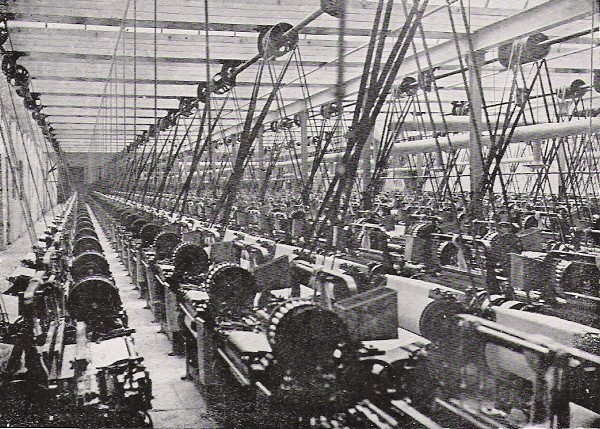
As industrialization took hold in Europe and the “satanic mills” were established, the cost of labour decreased, and the productivity of labour increased. For factories to become more profitable, cheap raw material was needed (which, thanks to limited land in Europe, wasn’t easily available). Enter the New World with its unlimited land, and India with its massive agricultural population. The Mughals had up to this point kept the British limited to a few ports in India, enabling Indian handicraft industries to survive.
All that changed as the empire declined and Britain gradually became the premier European power in India. Existing institutions were reshaped in its own favour. Investment in public goods began to take off, and a uniform currency was introduced. The welter of competing revenue rights on agricultural land was re-negotiated with zamindars. Most importantly, as India was forcibly opened to the global market, British joint-stock companies and railroads finally penetrated to the agricultural hinterland and connected supply (cheap raw material) with demand (industries in Europe).
So Britain began to leap ahead, buying ridiculously cheap raw materials, processing them in factories, and selling finished goods in India. The profits fueled investment in industrial technology, and productivity increased as agricultural workers moved to industrial jobs. Meanwhile, increasingly unemployed Indian artisans in handicraft industries returned to the agricultural jobs to eke out a living, since the demand for agricultural raw material was so huge. Thus began the “de-industrialization” of India.
Within a few decades from the 1860s to the 1920s, industries continued to become more productive, as they were only constrained by technology, and so European workers eventually achieved better standards of living. Agriculture, however, cannot indefinitely become more productive, as land is limited. And as a primarily agricultural nation, rural India quickly hit peak productivity and stagnated. And so Indian workers continued to remain in poverty.
Meanwhile Europe developed faster and faster. Global trade increased in volume, but India’s handicraft industries had lost their workers to the stagnant agricultural pool and it was unable to take advantage of this trend. With an economy that was stuck in a dead end, it’s not really a surprise that India fell behind Europe — one could say that the cards were literally stacked against it. And so India’s premier position in global trade was lost.